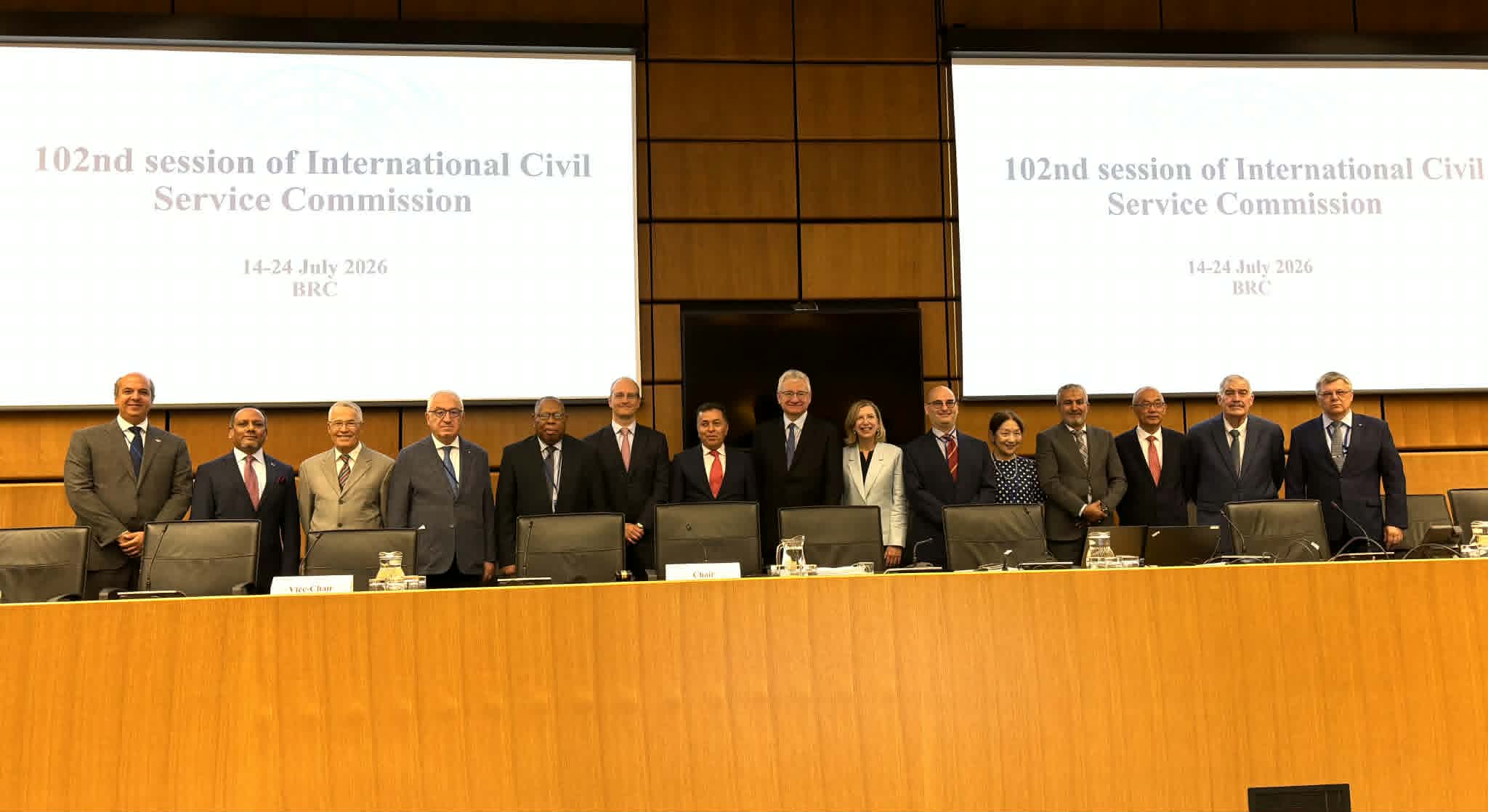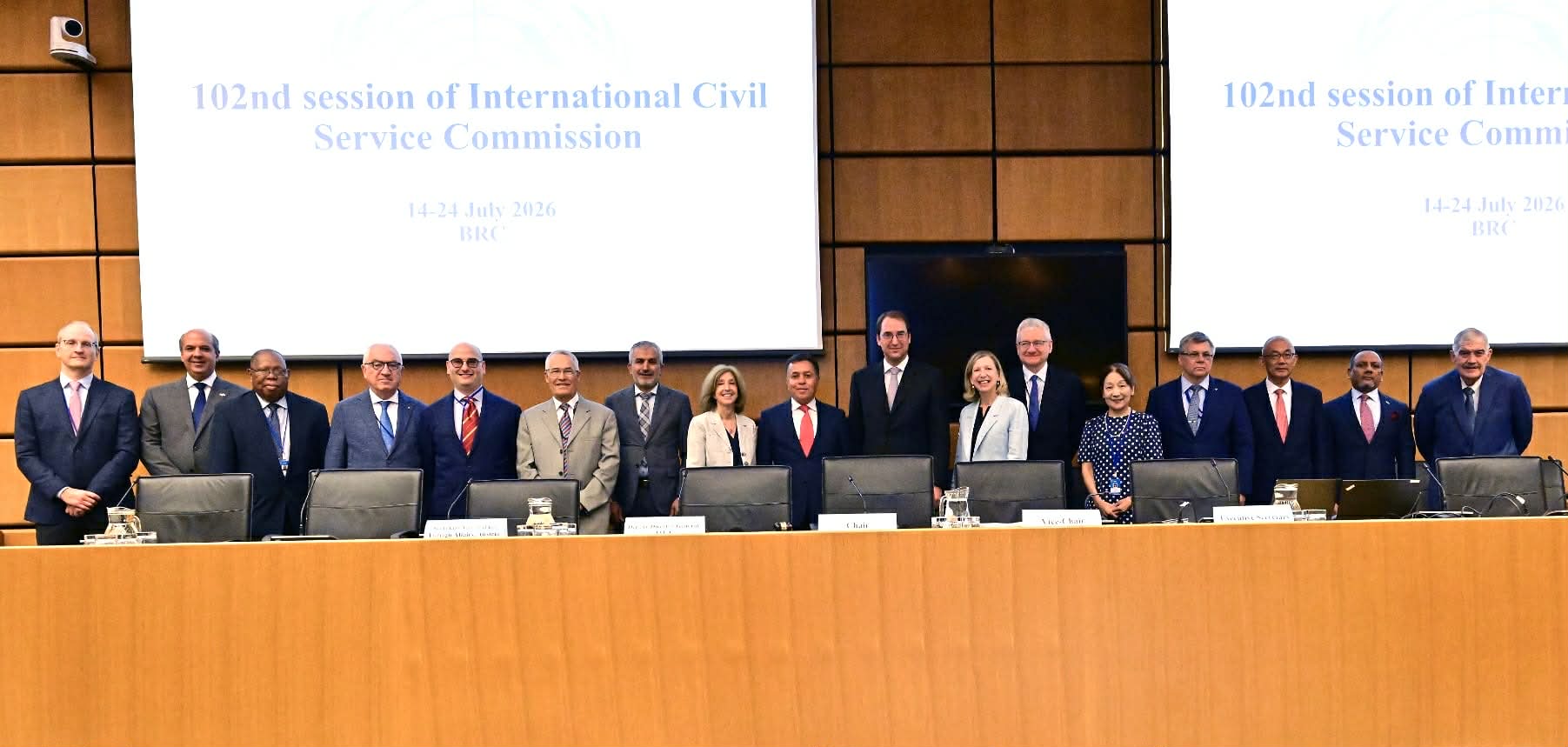
The Commission’s recommendations on the compensation package will proceed to the General Assembly for consideration.
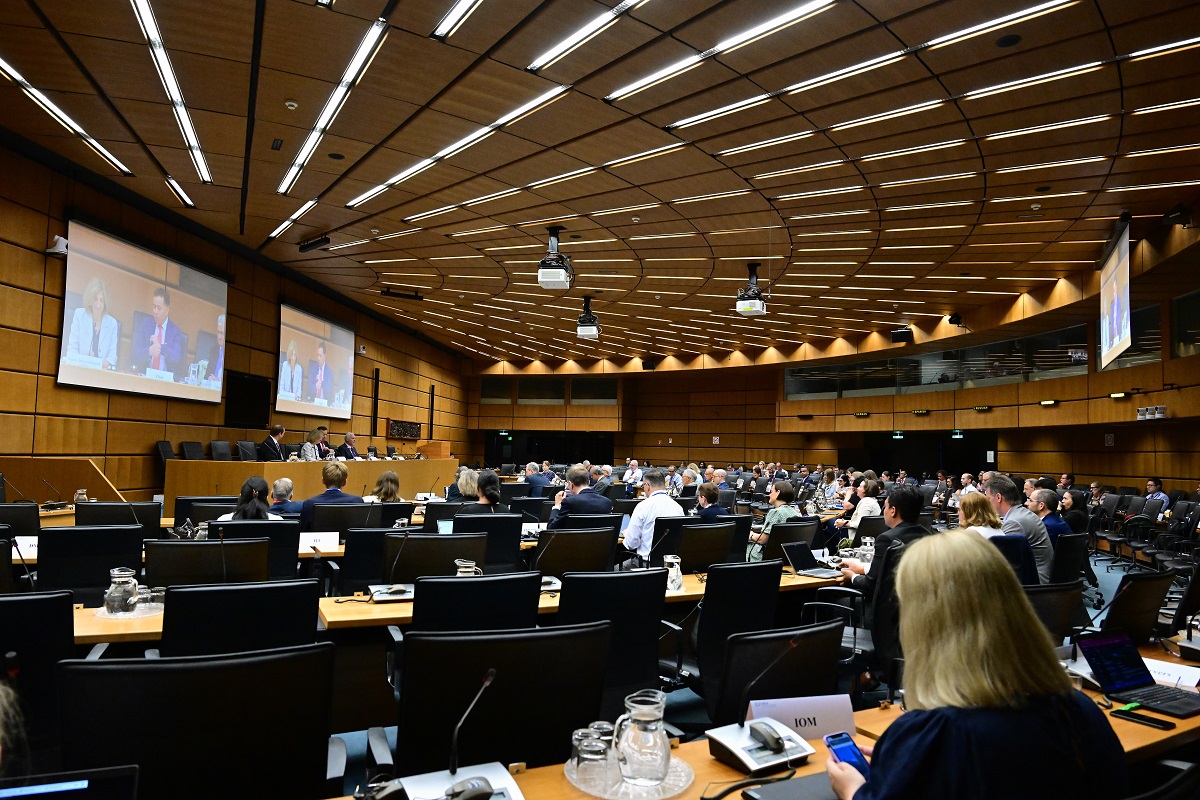
The International Civil Service Commission (ICSC) concluded its one hundred and second session in Vienna, Austria, on July 24, 2026, following ten days of deliberations on key issues relating to the conditions of service of staff across the United Nations common system.
Completion of the Comprehensive Review
The principal outcome of the session was the completion of the comprehensive review of the compensation package within the timeframe established by the General Assembly. Reflecting several years of analytical work and extensive deliberations by the Commission and its three working groups, the review marks a significant milestone in the Commission’s work. It was conducted on the premise of overall cost containment and sustainability, while preserving the agreed criteria of competitiveness and flexibility of the compensation package.
It was guided by the objectives established by the General Assembly, namely effective mandate delivery, flexibility, attractiveness, coherence, transparency, cost-effectiveness, stability and predictability. In finalizing its recommendations, the Commission reaffirmed its commitment to ensuring that the compensation framework across the United Nations common system remains equitable, competitive, and responsive to the evolving needs of organizations and staff.
The package includes recommendations on family and education-related support, mobility and field-service arrangements, rental subsidy, an optional family-hub model, teleworking compensation, and selected periodic review cycles. A concise item-by-item overview is available in the accompanying attachment: Key Recommendations At-A-Glance.
Net Remuneration Margin
In its resolution 80/236, the General Assembly had requested the Commission to explore options for a revised net remuneration margin range and a decreased desirable midpoint. It also requested to provide its recommendations, based on an analysis on the impact of such a midpoint on the United Nations common system, including on the current application of the Noblemaire principle, attraction and retention of staff members, and overall attractiveness and predictability of the compensation package, based on quantitative analysis and modelling of the budgetary implications.
Having reviewed the matter, the Commission noted the scope of the review and analysis requested by the General Assembly and proposed to report the results of the review to the Assembly at its eighty-third session in 2028. In this context, it further suggested to the Assembly that, pending the outcome of this review, the net remuneration at the base of the system, New York, should be maintained at its current level until 31 December 2028. If approved, any decline in purchasing power in New York, which serves as the base of the post adjustment system, would eventually be reflected in other duty stations through the operation of the post adjustment system, although the effects may vary by location.
Other Matters Considered by the Commission
In addition, the Commission considered a wide range of issues relating to the conditions of service of staff in the United Nations common system, launch of the 2026 round of surveys, implementation of the pilot project on salary survey methodologies, and the results of surveys of the best prevailing conditions of employment in New York for the General Service and Security Service categories, the standards of conduct for the international civil service, as requested by the General Assembly and monitored the implementation of decisions and recommendations of both the Commission and the General Assembly.
Additional Context
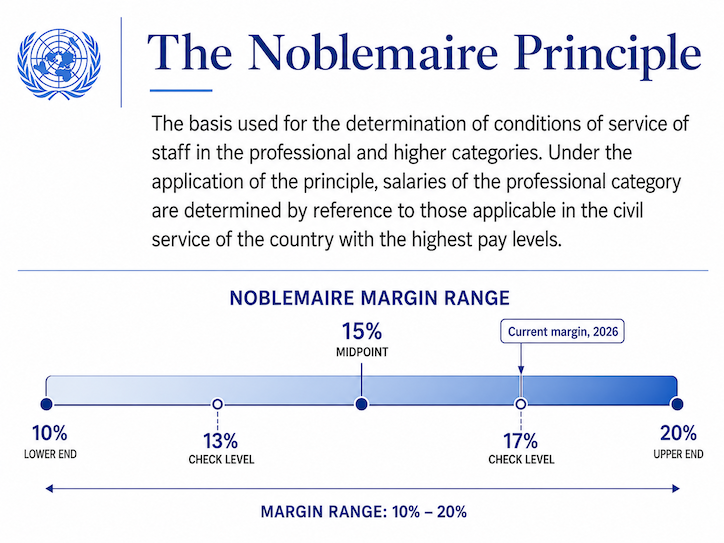
Under the Noblemaire principle, UN pay is benchmarked against that of the highest-paid national civil service, currently the U.S. federal civil service. The difference between the two, taking account of cost-of-living differences, is known as the net remuneration margin. The established range is 10 to 20 percent above the U.S. federal civil service, with a desirable midpoint of 15 percent, with check levels at 13 and 17 percent. The current margin stands at 17 percent.
If increases in New York's cost of living cause the margin to rise above the upper check level, the Commission takes action to maintain the margin at 17 percent. This process, known as margin management, involves maintaining New York net remuneration at a level that prevents the margin from exceeding the threshold. Operationally, this is achieved by scaling back the New York post adjustment index to keep the margin within the approved range. Any resulting loss in purchasing power in New York is then reflected in all other duty stations through the post adjustment system.
Next Steps
The Commission’s recommendations will be submitted to the General Assembly for consideration. Subject to the Assembly’s decisions, the comprehensive-review measures are proposed to take effect from July 1, 2027, with specific transition arrangements for selected elements. In addition, the General Assembly would also need to take any further decision on the net remuneration margin issue.
Posted on 28 July 2026